1. Executive Summary: Brand Strength vs Organic Growth Opportunity
Flowscape has a strong hybrid workplace product offering, covering desk booking, room booking, workplace analytics, visitor management, sensors, hardware, and office mapping. However, the SEO opportunity is not just to improve metadata or add more keywords.
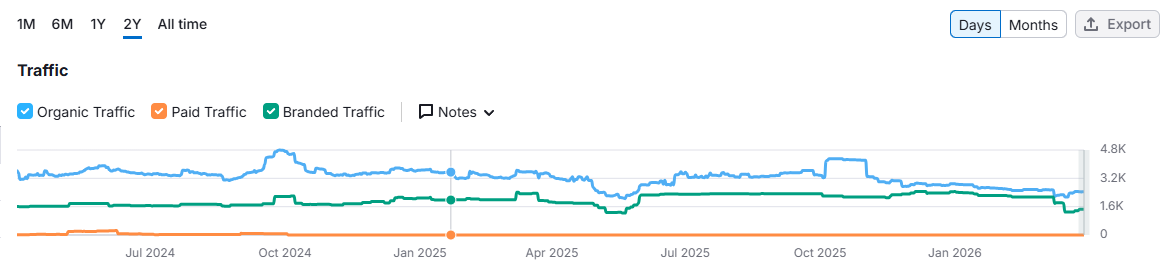
SEMrush insights: High brand reliance limits scalable non-branded growth.
The main challenge is that Flowscape's organic visibility appears heavily influenced by branded demand. SEMrush insights show that nearly 60% of organic traffic is tied to branded searches, while non-branded commercial visibility still has room to grow. This suggests that Flowscape is already known by part of the market, but is missing opportunities to reach buyers searching for solutions before they know the brand.
Strategic Goal
Shift Flowscape from brand-led visibility to stronger commercial, problem-led, and solution-led organic growth.
Expected Outcome
If the technical, content, and internal linking recommendations are implemented, Flowscape could improve visibility for high-intent B2B searches, strengthen demo journeys, and support more qualified organic leads.
| Finding | SEO interpretation | Strategic opportunity |
|---|---|---|
| Established organic footprint | The site has existing authority and search visibility to build from | Strengthen high-potential pages instead of relying only on new content creation |
| High brand dependence | Organic visibility is strongly influenced by existing awareness | Grow non-branded traffic around solution and pain-point searches |
| Stable keyword footprint | The site has visibility, but traffic growth has not strongly accelerated | Improve ranking depth for pages already close to page one |
| International visibility | Visibility is spread across multiple markets | Validate whether organic traffic aligns with priority revenue markets |
| Commercial ranking potential | Several non-branded commercial keywords are already close to page-one visibility | Improve existing landing pages to capture quicker ranking and traffic gains |
2. Technical SEO Finding: Legacy Domain Consolidation
During manual checks, I found that the old flowscape.se domain redirects to flowscapesolutions.com, but the redirects use 307 Temporary Redirects rather than permanent 301 or 308 redirects.
Examples checked:
- https://flowscape.se redirects to https://flowscapesolutions.com/
- https://flowscape.se/resources redirects to https://flowscapesolutions.com/resources
Google also still shows several flowscape.se URLs in search results, including support documentation pages. This suggests that the legacy domain migration may not be fully consolidated from an SEO perspective.
SEMrush backlink comparison also shows that the legacy flowscape.se domain still has a meaningful backlink profile, with a similar number of referring domains to the current .com domain. This makes proper redirect consolidation especially important.
Why it matters
If the migration is permanent, temporary redirects may weaken long-term consolidation signals. Legacy indexed URLs can also fragment brand signals and backlink equity across old and new domains.
Recommendation
Replace permanent legacy-domain redirects with 301 or 308 redirects, audit all indexed flowscape.se URLs, and decide whether support content should remain on the old support subdomain or move to the preferred brand domain.
3. Site Architecture Gap: Thin Hubs & Inconsistent URL Structure
Flowscape has several strong commercial pages, but the overall structure is inconsistent. Some important solution pages sit under /solutions/, while others sit at root level or under unrelated folders.
| Example | SEO issue | Recommendation |
|---|---|---|
/solutions/desk-management
and
/desk-booking
|
Similar desk booking intent across two pages | Decide the primary ranking URL and differentiate or consolidate overlapping content |
/the-flowmap
|
Important feature page sits outside /solutions or /products | Move or clearly link it within the relevant solution/product structure |
/solutions/flowplanner
|
Strong solution page, but not clearly surfaced in the main Solutions dropdown | Add it to hub content and navigation where relevant |
/hardwares/visitor-management-solution
|
Visitor Management is a software-led solution but sits under a hardware-style URL | Move or replicate under /solutions/visitor-management-software |
Why it matters
A clearer URL and internal linking structure would help users understand the product ecosystem and help search engines identify the primary page for each commercial keyword.
4. Keyword Opportunity & Striking-Distance Sprint
SEMrush data shows that Flowscape already ranks for several valuable non-branded commercial keywords, but some pages only partially match search intent. This creates a near-term opportunity to improve pages that are already close to stronger positions, rather than relying only on new content creation.
| Opportunity type | Example keywords | Current insight | Strategic action |
|---|---|---|---|
| Core commercial keywords | desk booking software, room booking system, workplace analytics software | High-value B2B terms linked to solution evaluation | Align solution page copy with high-intent commercial search terms |
| Striking-distance keywords | hybrid workplace solutions, workplace analytics, desk booking system, conference room booking system | Several keywords already rank close to page-one/top-five positions | Improve H1s, copy, internal links, FAQs, and page alignment |
| Problem-led searches | how to reduce office space costs, how to measure office occupancy | Captures buyers before they compare vendors | Build educational content clusters around workplace problems |
| Integration-led searches | Microsoft Teams room booking, Outlook booking, Google Workspace booking | Buyers are searching for room and workplace solutions that fit into their existing tech stack | Create dedicated integration or compatibility pages for supported platforms |
| Local/Nordic keywords | workplace management software Sweden, arbetsplatsanalys, kontorsoptimering | Relevant because Flowscape has Swedish/Nordic market presence | Support regional visibility with localised content |
Recommendation: Prioritise striking-distance commercial keywords first, because these pages already have ranking signals. Then expand into problem-led, integration-led, and regional content to build broader topical authority.
5. Competitor & SERP Gap Findings
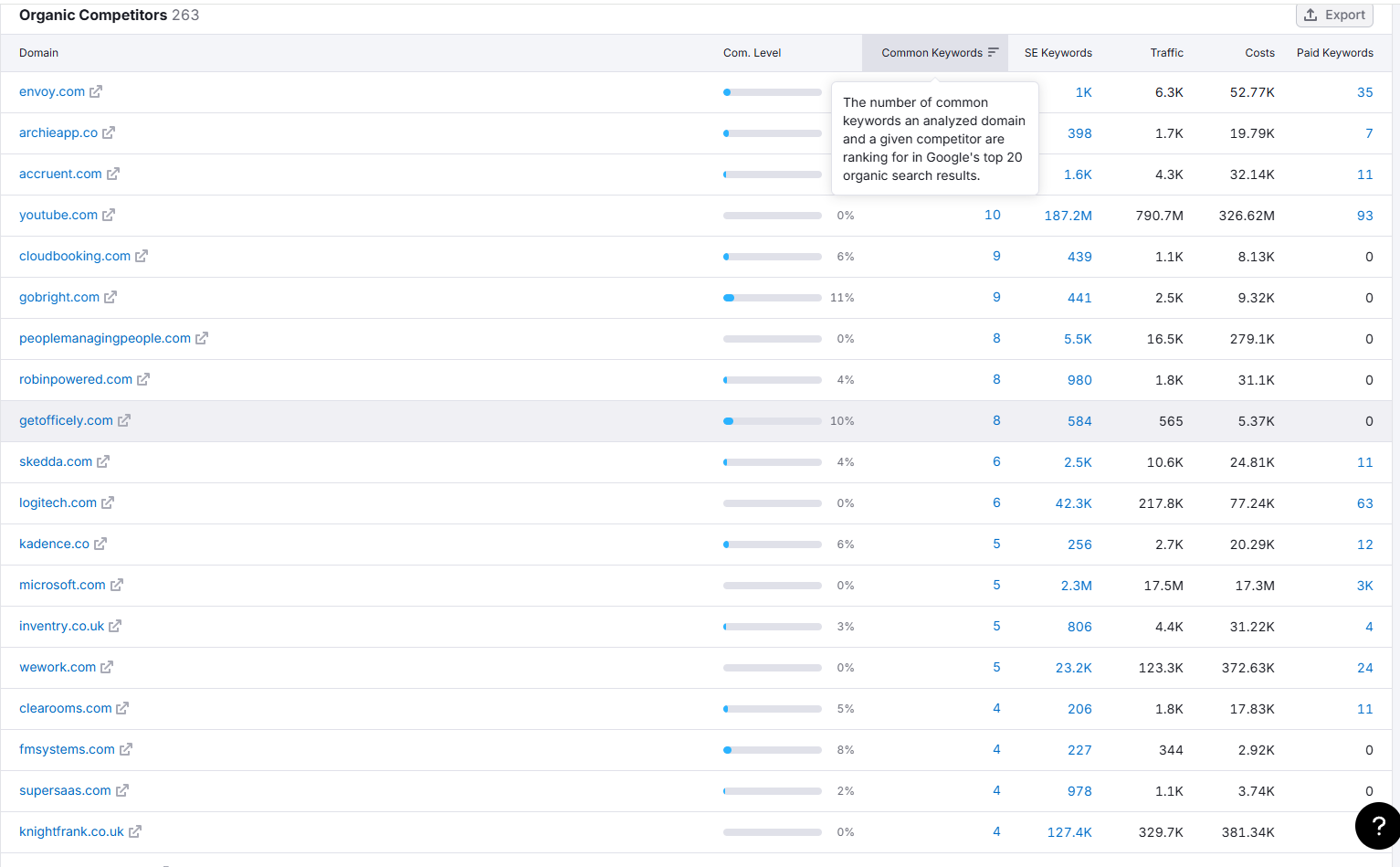
SEMrush competitor data shows that Flowscape’s organic search competition is broader than direct workplace software vendors. While companies such as Envoy, Archie, GoBright, Robin, and Accruent compete for core commercial terms, larger technology brands and publishers also appear across related integration, hardware, and informational searches.
| Competitor type | Examples | SEO implication |
|---|---|---|
| Direct SaaS competitors | Envoy, Archie, GoBright, Robin, Accruent, Cloudbooking | Compete for commercial terms such as desk booking software, room booking systems, visitor management, and workplace management software |
| Ecosystem / SERP competitors | Microsoft, Logitech | Compete in search results for integration, meeting room, hardware, and workplace technology-related queries |
| Content competitors | People Managing People, workplace blogs, HR/workplace strategy publishers | Capture early-stage informational demand before buyers start comparing vendors |
A keyword gap review also shows that competitors have stronger visibility for several high-intent desk booking and room booking terms where Flowscape has limited or no visibility. This suggests that Flowscape needs to compete across three SEO layers: commercial solution searches, integration-led searches, and early-stage informational searches.
Key insight: Flowscape’s SEO competition extends beyond direct SaaS competitors. To grow non-branded traffic, the brand should strengthen high-intent commercial landing pages and build supporting content around integrations, buyer research, and workplace planning topics.
Recommendation: Flowscape should strengthen its commercial landing pages and build a focused supporting content layer around buyer evaluation, integrations, and workplace use cases.
| Content opportunity | Purpose |
|---|---|
| Comparison pages | Capture buyers evaluating different workplace platforms |
| Alternative pages | Reach users searching for competitor alternatives |
| Integration pages | Capture searches around supported integrations such as Microsoft Teams, Outlook, Google Workspace, and workplace hardware |
| Buyer guides | Support users comparing workplace management solutions |
| Use-case content | Capture early-stage searches around office utilisation, hybrid work, and workplace planning |
Flowscape should also make its differentiators more visible across these pages, especially its software + hardware offering, workplace analytics, sensors, FlowMap, ISO certifications, enterprise customer base, and global delivery capability.
6. Content & Conversion SEO Findings
Flowscape has strong trust signals, including customer logos, testimonials, certifications, integrations, office details, and support information. However, several commercial pages could do more to connect features with business outcomes.
| Area | Finding | Recommendation |
|---|---|---|
| Homepage | Strong overview, but more feature-led than outcome-led | Connect features to outcomes such as cost reduction, better utilisation, fewer ghost meetings, and improved employee experience |
| CTAs | CTAs are visible but generic | Use intent-specific CTAs such as "Book a workplace management demo" or "Explore desk booking software" |
| Lead forms | Whitepaper forms create a lead generation opportunity, but the value proposition could be clearer | Add stronger supporting copy that explains what the reader will learn, who the whitepaper is for, and why the resource is credible |
| Trust signals | Strong existing proof, but limited measurable outcomes | Add case studies with results, implementation examples, and usage metrics |
| Resource content | Webinars and events provide useful expert content, but are underused for organic search | Repurpose webinar and event topics into SEO-focused guides, articles, FAQs, and topic clusters |
7. Structured Data & AI Search Readiness
Structured data is partially implemented across the site, but it is not yet consistent across key page templates. The solution page example includes schema markup, but the implementation should be cleaned up and expanded across other commercial and resource pages.
For AI search and enhanced SERP visibility, Flowscape should use structured data to help search engines clearly understand page type, product/service relevance, FAQs, events, and breadcrumbs.
| Page type | Suggested schema |
|---|---|
| Homepage |
Organization,
WebSite
|
| Solution pages |
SoftwareApplication,
Product,
FAQPage
BreadcrumbList
|
| Product pages |
Product,
FAQPage
BreadcrumbList
|
| Event / webinar pages |
Event,
FAQPage,
BreadcrumbList
|
| Resource Listing pages |
CollectionPage,
BreadcrumbList
|
| Blog posts |
Article,
BlogPosting
BreadcrumbList
|
Key technical observations:
-
The event page does not currently have strong structured data support for the webinar/event itself. It should include
Eventschema with the event name, date, time, location, language, registration URL, and organizer. -
The Desk Management solution page already uses structured data, but the JSON-LD should be improved by wrapping multiple schema entities inside
@graph. The page should also includeFAQPageschema because visible FAQ content already exists on the page.
There is also an issue with the Open Graph URL on the Desk Management page:
Incorrect (Current):
Corrected:
SERP review shows that question-led results are being captured by competitors and broader content sites. This creates an opportunity for Flowscape to target buyer-intent questions directly on commercial pages, such as:
- What is a desk booking system?
- How does desk booking work with Microsoft Teams?
- What are the best desk booking system alternatives?
- What is the difference between desk booking and hot desking?
- How do companies manage hybrid office seating?
Recommendation: Implement relevant schema markup across all key page templates and support it with FAQ-led, snippet-friendly content on commercial pages. For solution and product pages, add short visible FAQ sections where useful, and apply FAQPage schema only when the same questions and answers are present on the page. This will not guarantee AI Overview visibility, but it will improve content clarity, structured understanding, eligibility for enhanced search results, and Flowscape’s readiness for AI-driven search experiences.
Priority actions:
- Standardize schema by page template.
- Add
FAQPageschema where FAQs are visible. - Add
Eventschema to webinar/event pages. - Use
@graphfor pages with multiple schema types. - Validate all schema using Google Rich Results Test and Schema.org Validator.
- Fix incorrect canonical and Open Graph URL issues where present.
8. Priority Roadmap
| Issue | Recommended action | Priority | Expected business impact |
|---|---|---|---|
| Legacy 307 redirects | Change permanent .se redirects to 301/308 where migration is permanent |
High | Improves domain consolidation and reduces authority fragmentation risk |
| Thin/inconsistent hub structure | Rebuild /solutions and /products; clarify URL structure for key solution pages |
High | Improves search intent alignment and user navigation |
| Under-integrated Visitor Management page | Move or replicate under /solutions/visitor-management-software and strengthen internal links |
High | Improves topical clarity and discovery of a commercial solution |
| Striking-distance keywords | Optimise pages ranking positions 4-20 with stronger headings, copy, FAQs, and internal anchors | High | Supports faster non-branded ranking growth |
| Competitor keyword gaps | Create comparison, alternative, integration, and buyer-guide content | Medium | Captures decision-stage buyers |
| Underused resource content | Repurpose webinars and resource content into SEO articles, guides, and FAQ-led commercial support content | Medium | Builds topical authority and captures problem-aware users |
| Structured data gaps | Standardize schema across key templates, add FAQPage where FAQs are visible, add Event schema to webinar pages, and fix schema/OG URL inconsistencies | Medium | Improves structured understanding, enhanced-search eligibility, and AI-search readiness |
| Generic CTAs | Make CTAs more page-specific and outcome-led | Medium | Improves conversion flow from organic landing pages |
Final Note
This audit shows that Flowscape's biggest SEO opportunity is not basic optimisation, but improving how technical foundations, site architecture, content strategy, and conversion paths work together. By consolidating legacy domain signals, strengthening commercial hub pages, and targeting non-branded buyer intent, Flowscape can build a stronger organic acquisition channel and support higher-quality demo enquiries.